What Is SEO and How Does It Help Businesses Grow?
In today’s digital world, having a website is only the first step towards building a successful online business. With thousands of businesses competing for customer attention, simply launching a website does not guarantee that people will discover your products or services. Your potential customers need to find you when they search online for solutions that your business provides.
This is where Search Engine Optimization (SEO) becomes important.
SEO helps businesses improve their visibility in search engine results, attract relevant visitors, build online credibility, and generate potential leads without depending entirely on paid advertising. Whether you operate a small business, startup, e-commerce store, or established company, a well-planned SEO strategy can support sustainable digital growth.
But what exactly is SEO, how does it work, and why should businesses invest in it?
Let’s explore everything business owners need to know about SEO and its role in long-term business growth.
What Is SEO (Search Engine Optimization)?
Search Engine Optimization, commonly known as SEO, is the process of improving a website to make it easier for search engines to discover, understand, and present its pages to people searching for relevant information, products, or services.
In simple terms, SEO helps your website appear in relevant unpaid search results on platforms such as Google.
For example, imagine someone in Pune searches for:
Best website development company in Pune
Digital marketing services for small businesses
Affordable SEO services in Pune
Professional e-commerce website development
If your business offers these services, SEO can help improve the chances of your website appearing for relevant searches.
SEO involves several activities, including:
Keyword research and search intent analysis.
Website content optimization.
Technical SEO improvements.
Website structure and internal linking.
Image optimization.
Quality backlink development.
Local search optimization.
Performance monitoring and improvements.
According to Google’s SEO Starter Guide, SEO helps search engines understand website content and helps users discover relevant pages through search.
How Does SEO Work?
Search engines use automated systems to discover and organize information available across the internet. Google generally follows three major stages: crawling, indexing, and serving search results.
Understanding these stages helps business owners understand why SEO involves more than simply adding keywords to a website.
1. Crawling: Discovering Website Content
Crawling is the process through which search engines discover website pages using automated programs called crawlers.
These crawlers follow links, explore website structures, and identify new or updated content.
For example, when you publish a new service page or blog post, search engine crawlers may discover it through your website’s internal links or sitemap.
How businesses can help:
Maintain a clear website structure.
Create and submit an XML sitemap.
Fix broken internal links.
Avoid accidentally blocking important pages from crawling.
Use descriptive URLs.
2. Indexing: Understanding and Storing Information
After discovering a page, search engines analyze its content and other relevant information to determine whether it should be included in their index.
During this process, search engines attempt to understand what the page is about and how it relates to other information.
For example, a website page explaining website development services should clearly communicate its services, target audience, features, and relevant information.
How businesses can help:
Publish original and informative content.
Use relevant page titles and headings.
Organize content into meaningful sections.
Add descriptive image alt text.
Avoid duplicate or misleading content.
How businesses can help:
Publish original and informative content.
Use relevant page titles and headings.
Organize content into meaningful sections.
Add descriptive image alt text.
Avoid duplicate or misleading content.
3. Ranking and Serving Search Results
When someone searches for a particular query, search engines use numerous systems to identify and display relevant results.
The order in which pages appear depends on multiple factors, including relevance, content quality, context, and other ranking signals.
For example, someone searching for an SEO company in Pune is likely looking for businesses offering SEO services in that location.
Your website should clearly communicate your services, expertise, service area, and how customers can contact you.
Important: Getting indexed does not guarantee a particular ranking or position. SEO is an ongoing process that requires regular monitoring and improvement.
Important: Getting indexed does not guarantee a particular ranking or position. SEO is an ongoing process that requires regular monitoring and improvement.
Why Is SEO Important for Business Growth?
SEO is not just about improving website rankings. It is about making your business easier to discover when potential customers are actively looking for what you offer.
Here are some important ways SEO contributes to business growth.
1. Improves Online Visibility
Imagine having a professionally designed website with excellent products and services, but very few people know that it exists.
Without proper online visibility, even a good business website may struggle to attract visitors.
SEO helps improve your website’s presence in relevant search results, making it easier for potential customers to discover your business.
For example, a local interior design company in Pune can create optimized service pages targeting searches related to residential interior design, office interiors, and modular kitchens.
When the website provides useful, relevant information, it has a better opportunity to reach people searching for those services.
2. Brings Relevant Organic Website Traffic
Organic traffic refers to visitors who reach your website through unpaid search engine results.
Unlike paid advertising, organic search traffic does not require paying for every individual click.
However, SEO still requires investment in content creation, technical improvements, strategy, and ongoing optimization.
The biggest advantage is that your website can continue attracting relevant visitors through useful content and optimized pages over time.
For example:
A company selling handmade jewellery could create pages and articles covering:
Handmade jewellery collections.
Traditional jewellery designs.
Jewellery care tips.
Jewellery buying guides.
Custom jewellery options.
These pages can help attract visitors at different stages of their buying journey.
3. Generates Quality Business Leads
Getting website traffic is useful, but attracting visitors who are genuinely interested in your products or services is even more valuable.
SEO helps businesses target relevant keywords based on what potential customers are searching for.
Consider the difference:
General Search | High-Intent Search |
|---|---|
What is website design? | Website development company in Pune |
What is SEO? | Professional SEO services for businesses |
What is ERP software? | Custom ERP software development company |
What is digital marketing? | Digital marketing agency for small businesses |
The second category often indicates stronger commercial intent.
By developing relevant landing pages, clear service descriptions, contact forms, and calls to action, businesses can turn relevant website visitors into enquiries.
4. Builds Brand Awareness and Credibility
Customers often research a business before making a purchasing decision.
A website that consistently provides useful information, answers customer questions, and presents services clearly can help establish trust.
For example, an IT company can publish informative blogs about website development, SEO, mobile applications, and business automation.
This helps potential customers understand the company’s services while giving them useful information to make better decisions.
Remember that SEO visibility alone does not establish credibility. Your content, business information, service quality, and customer experience also matter.
5. Supports Long-Term Marketing Growth
Paid advertising can help businesses reach potential customers quickly, but visibility from advertising generally depends on an active advertising budget.
SEO works differently.
A well-optimized page can continue attracting organic visitors after publication, provided it remains relevant, accessible, and competitive.
This makes SEO an important part of a long-term digital marketing strategy.
Businesses can combine SEO with Google Ads, social media marketing, and content marketing to build a more balanced online presence.
6. Helps Small Businesses Compete Online
Small businesses do not always have the same advertising budgets as large companies.
However, they can still build online visibility by focusing on specific products, services, locations, and customer requirements.
For example, instead of targeting a broad keyword such as “digital marketing services,” a Pune-based business could develop relevant content around:
Digital marketing services for restaurants in Pune.
SEO services for local businesses.
Website design for small businesses.
Local SEO for service providers.
A focused SEO strategy can help smaller businesses reach audiences with more specific requirements.
7. Improves Website User Experience
SEO and website user experience are closely connected.
A website should not only be discoverable but also easy to navigate and understand.
A good website experience includes:
Mobile-responsive layouts.
Clear navigation menus.
Fast-loading pages.
Readable typography.
Properly organized content.
Descriptive buttons and calls to action.
Accessible and meaningful page elements.
These improvements make it easier for visitors to explore your website and find the information they need.
What Are the Different Types of SEO?
SEO consists of multiple areas that work together to improve a website’s search visibility.
For most businesses, the main categories include on-page SEO, off-page SEO, technical SEO, and local SEO.
1. On-Page SEO
On-page SEO focuses on optimizing the content and elements available directly on your website.
It helps search engines and visitors understand what each page offers.
Important on-page SEO activities include:
Keyword research.
SEO-friendly title tags.
Meta descriptions.
Proper H1, H2, and H3 headings.
Content optimization.
Internal linking.
Image alt text.
Descriptive URL structures.
Example: A website development company can create a dedicated page for website development services in Pune instead of placing all its services on a single generic page.
2. Off-Page SEO
Off-page SEO involves activities performed outside your website to build its reputation, authority, and online presence.
Some common activities include:
Relevant backlink building.
Digital PR.
Business directory listings.
Brand mentions.
Industry-related collaborations.
Genuine customer reviews.
Quality and relevance are more important than collecting a large number of unrelated backlinks.
Avoid buying spammy backlinks or participating in manipulative link schemes.
3. Technical SEO
Technical SEO focuses on improving the technical foundation of your website so search engines can crawl, understand, and access its content effectively.
Important technical SEO activities include:
Improving website loading performance.
Fixing crawling and indexing issues.
Creating XML sitemaps.
Implementing HTTPS.
Fixing broken links.
Managing duplicate URLs and canonical tags.
Improving mobile usability.
Implementing appropriate structured data.
Technical SEO is especially important for websites with multiple pages, e-commerce stores, and complex website structures.
4. Local SEO
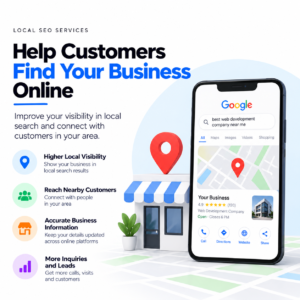
Local SEO helps businesses improve their visibility when people search for products or services in a particular geographic area.
It is especially useful for restaurants, clinics, consultants, retail stores, agencies, and other businesses serving specific locations.
For example, a business targeting customers in Pune may want to appear for searches such as:
SEO company in Pune.
Website designing company in Pune.
Best digital marketing services in Pune.
Website development company near me.
Important local SEO activities include:
Creating and verifying a Google Business Profile.
Maintaining accurate business information.
Selecting relevant business categories.
Adding genuine business photos.
Collecting authentic customer reviews.
Maintaining consistent business contact information.
Creating useful location-specific website content.
How Can Businesses Implement an Effective SEO Strategy?
SEO becomes more manageable when businesses follow a structured process rather than making random website changes.
Here is a practical approach.
Step 1: Understand Your Business and Target Audience
Before selecting keywords, identify what your business offers and who your potential customers are.
Ask yourself:
What products or services do we provide?
Who is most likely to purchase them?
Which locations do we serve?
What problems do our customers want to solve?
What makes our offering different?
These answers help build an SEO strategy aligned with actual business goals.
Step 2: Conduct Keyword Research
Keyword research helps identify the words and phrases people use when searching online.
Start by identifying:
Primary service keywords.
Location-based keywords.
Informational keywords.
Commercial investigation keywords.
Transactional keywords.
You can use tools such as Google Keyword Planner, Google Search Console, and other keyword research platforms.
Do not select keywords only because they appear popular. Consider whether the search intent matches your products or services.
Step 3: Optimize Your Website Pages
Each important page should have a clear purpose.
For example, a website development company may create separate pages for:
Website Development Services.
WordPress Website Development.
E-commerce Website Development.
Mobile App Development.
SEO Services.
Optimize each page with relevant headings, useful descriptions, appropriate keywords, images, and internal links.
Step 4: Publish Helpful SEO Content
Blogging is an effective way to address customer questions and build topical coverage.
For example, an IT company could publish articles about:
What Is SEO and How Does It Work?
How Much Does Website Development Cost in India?
WordPress vs Custom Website Development.
Benefits of ERP Software for Small Businesses.
How to Choose a Mobile App Development Company.
Your content should answer real questions instead of simply repeating keywords.
Local SEO helps businesses improve their visibility when people search for products or services in a particular geographic area.
It is especially useful for restaurants, clinics, consultants, retail stores, agencies, and other businesses serving specific locations.
Step 5: Improve Technical SEO
Review your website regularly for technical problems.
Pay attention to:
Mobile responsiveness.
Page loading performance.
Indexing issues.
Broken links.
Sitemap accessibility.
HTTPS security.
Duplicate content.
Website navigation.
Tools such as Google Search Console and PageSpeed Insights can help identify areas that need attention.
Step 6: Build Your Local Online Presence
If your business serves customers in Pune or nearby areas, local SEO can help improve its discoverability.
Create or optimize your Google Business Profile and ensure that your business name, address, contact details, hours, and categories are accurate.
Publish useful location-specific website content where it genuinely helps customers.
Avoid creating multiple low-quality pages simply by changing the city name.
Step 7: Monitor SEO Performance
SEO requires continuous evaluation.
Monitor the following indicators:
SEO Metric | What It Helps You Understand |
|---|---|
Organic clicks | Visitors arriving through unpaid search results |
Impressions | How frequently your pages appear in search results |
Search queries | What people search before discovering your website |
Average position | Your website’s average position for reported searches |
Organic conversions | Enquiries, purchases, or other valuable actions from organic visitors |
Indexed pages | Pages included in Google’s index |
Engagement | How visitors interact with your website |
Google Search Console is particularly useful for understanding search performance and identifying technical issues.
How Long Does SEO Take to Show Results?
One of the most common questions business owners ask is how quickly SEO can improve website rankings.
The honest answer is that SEO does not have a fixed timeline.
Results depend on several factors, including:
Website age and existing online presence.
Industry competition.
Keyword difficulty.
Website technical condition.
Quality and relevance of content.
Backlink profile.
Consistency of optimization.
Search engine updates.
Common SEO Mistakes Businesses Should Avoid
Even businesses investing in SEO sometimes struggle because of avoidable mistakes.
Here are some common problems and their practical solutions.
Common Mistake | Recommended Solution |
|---|---|
Repeating keywords excessively | Use natural language and relevant keyword variations |
Publishing copied content | Create original and useful information |
Ignoring mobile users | Test and optimize website layouts across devices |
Using duplicate page titles | Write unique titles for important pages |
Neglecting technical SEO | Perform regular technical website audits |
Building irrelevant backlinks | Focus on relevant and trustworthy websites |
Ignoring local SEO | Maintain an accurate Google Business Profile |
Publishing without a strategy | Align content with audience needs and search intent |
Expecting immediate results | Monitor progress over a realistic period |
A successful SEO strategy should focus on improving the website and its usefulness rather than trying to manipulate search engines.
Why Should You Consider Professional SEO Services?
SEO involves several interconnected activities, from keyword research and content development to technical optimization and performance monitoring.
For business owners managing everyday operations, handling all these activities independently can become challenging.
Working with a professional SEO team can help businesses develop a structured strategy based on their goals, industry, competition, and target audience.
A professional SEO service may include:
SEO Audit: Identifying technical issues, content gaps, and opportunities for improvement.
Keyword Research: Finding relevant keywords based on search intent and business objectives.
On-Page Optimization: Improving website content, headings, metadata, and internal linking.
Technical SEO: Addressing crawling, indexing, performance, and website structure.
Off-Page SEO: Developing relevant and ethical strategies to improve online authority.
Local SEO: Improving business visibility for relevant location-based searches.
SEO Reporting: Tracking organic traffic, search impressions, clicks, conversions, and other relevant performance indicators.
The right SEO approach depends on your business requirements. A small local business may need a different strategy from a large e-commerce company.
How Devcode Software Solutions Pvt. Ltd. Can Help Your Business Grow Through SEO
Building an online presence requires more than publishing a website. Your business needs a clear strategy to help potential customers discover its products and services.
Devcode Software Solutions Pvt. Ltd. provides SEO services designed to improve website visibility, strengthen organic search presence, and help businesses attract relevant website traffic.
Its SEO service offerings include:
On-page SEO optimization.
Technical SEO services.
Off-page SEO and link-building strategies.
Keyword research and content strategy.
Local SEO optimization.
E-commerce SEO.
SEO performance monitoring.
Whether you are a startup establishing your online presence or an existing business looking to improve organic visibility, an SEO strategy should be developed around your actual business objectives.
Businesses looking for an SEO company in Pune can explore Devcode’s SEO Services to understand the available solutions.
You can also visit the Devcode Software Solutions website to explore its broader digital services.